Minimal-downtime migration: initial load, then CDC
- Schema converted
- Validated
- Resumable
- Parallel writes
Start a stream. Watch rows move.
Cross-database migration moves schema and data from one engine to another — for example, MySQL to PostgreSQL — without manual DDL, without lossy intermediate exports, and without staging tables. The hard part is rarely reading rows; it is converting types correctly, recreating indexes and foreign keys in a safe order, and recovering when a load stops mid-copy.
DBConvert Streams handles those parts in one stream: schema is converted automatically with visible type mappings, eligible loads are split into primary-key ranges with saved progress, and every load is checked at both ends: before it starts, you see what will happen to each target table; after it finishes, totals and rows are compared with the source, and the rows that differ open side by side with their source values in Compare.
Migrates from
Databases, files, and object storage, self-hosted or managed.
 MySQL
MySQL  MariaDB
  Percona
  PostgreSQL
  Amazon RDS
  AWS Aurora
  Google Cloud SQL
  Azure Database
  Neon
Neon  Supabase
  Databricks Lakebase
  YugabyteDB
  DigitalOcean
  S3 / MinIO
  Local files
Migrates to
Any PostgreSQL or MySQL-compatible database, plus files and object storage.
- MySQL
- MariaDB
- Percona
- PostgreSQL
- Amazon RDS
- AWS Aurora
- Google Cloud SQL
- Azure Database
- Neon
- Supabase
- Databricks Lakebase
- YugabyteDB
- DigitalOcean
- S3 / MinIO
- Local files
 Snowflake
Schema is converted automatically between MySQL and PostgreSQL; see CDC replication to keep the target current after the load. Migrating from Oracle or SQL Server is covered by the DBConvert desktop tools instead.
Measured Performance
Load Throughput You Can Measure
Real numbers from local migration tests.
25M rows
in 48 seconds
260M rows
49 GB in 8 minutes 18 seconds
101 MB/s
steady from 25M to 260M rows
8 min 56 s
the same 49 GB into Snowflake
MySQL → PostgreSQL local benchmark, end to end, on a single desktop machine. Performance depends on hardware, row size, and database configuration.
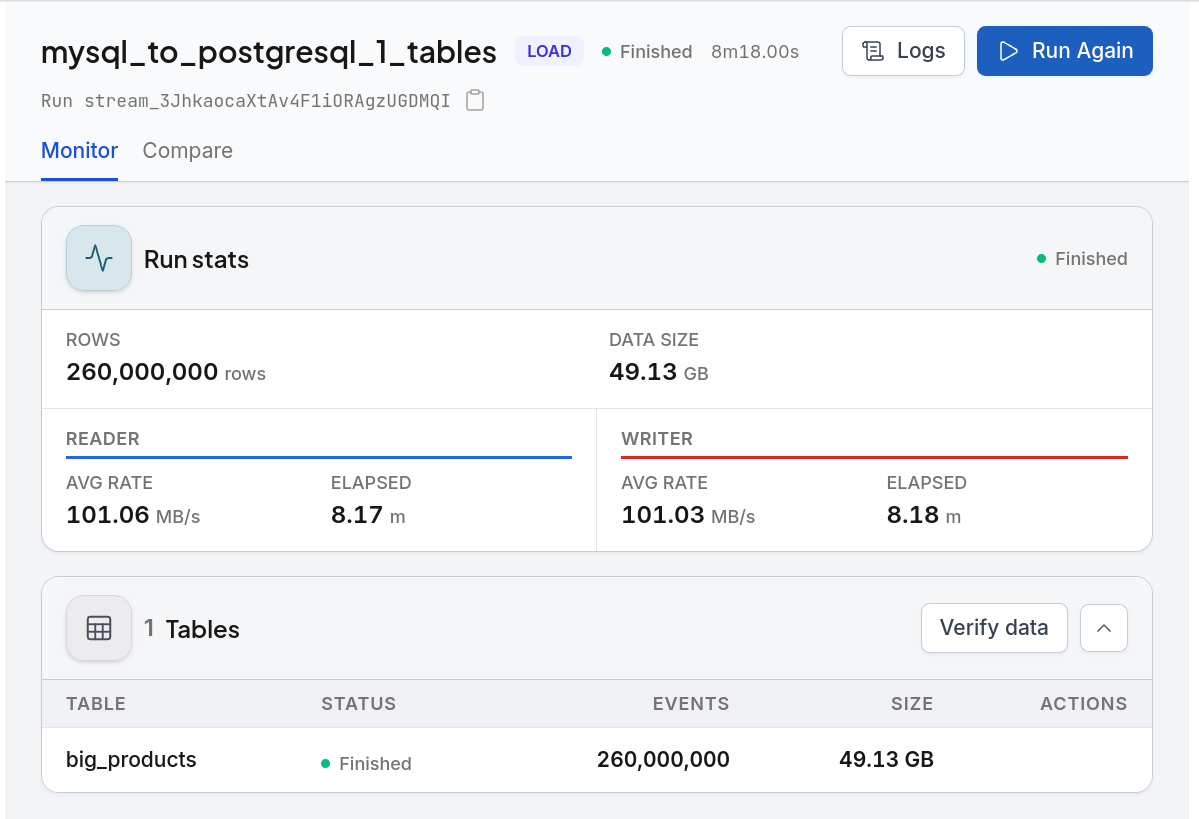
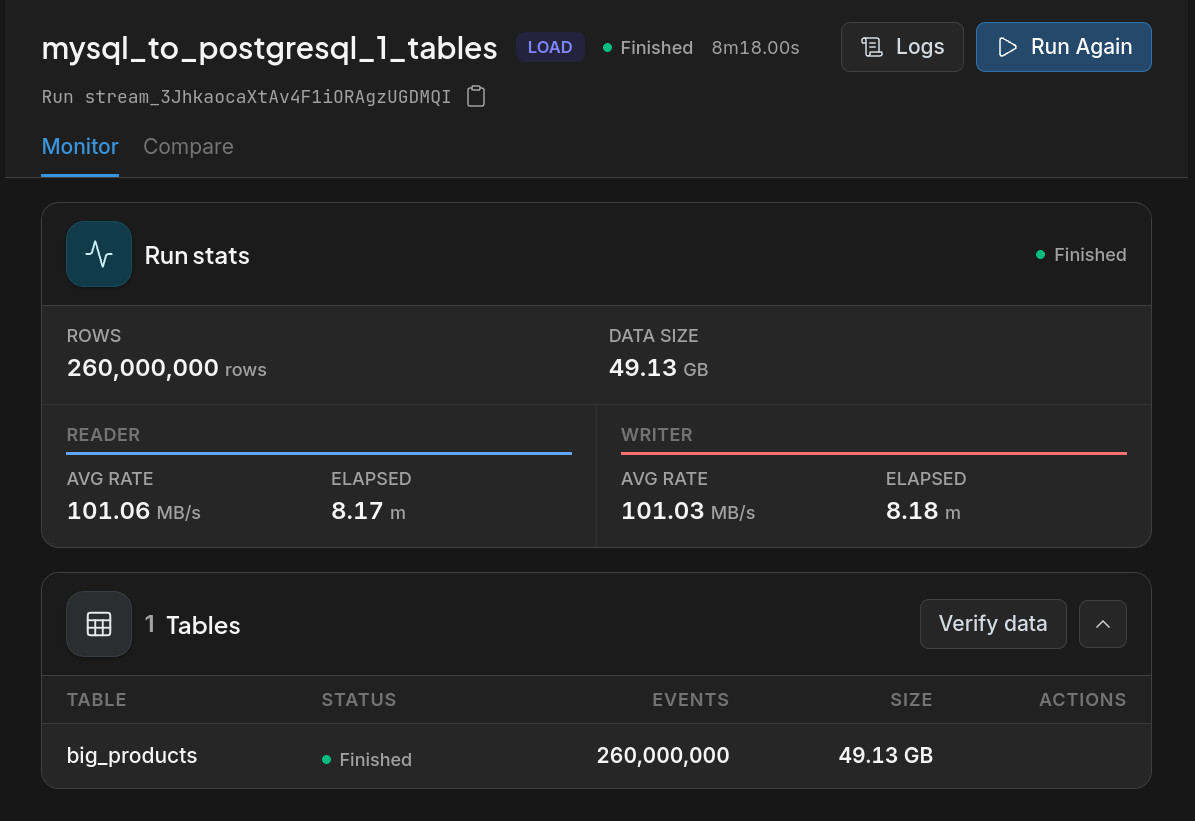
The 260-million-row run: one table, 49.13 GB, finished in 8 minutes 18 seconds.
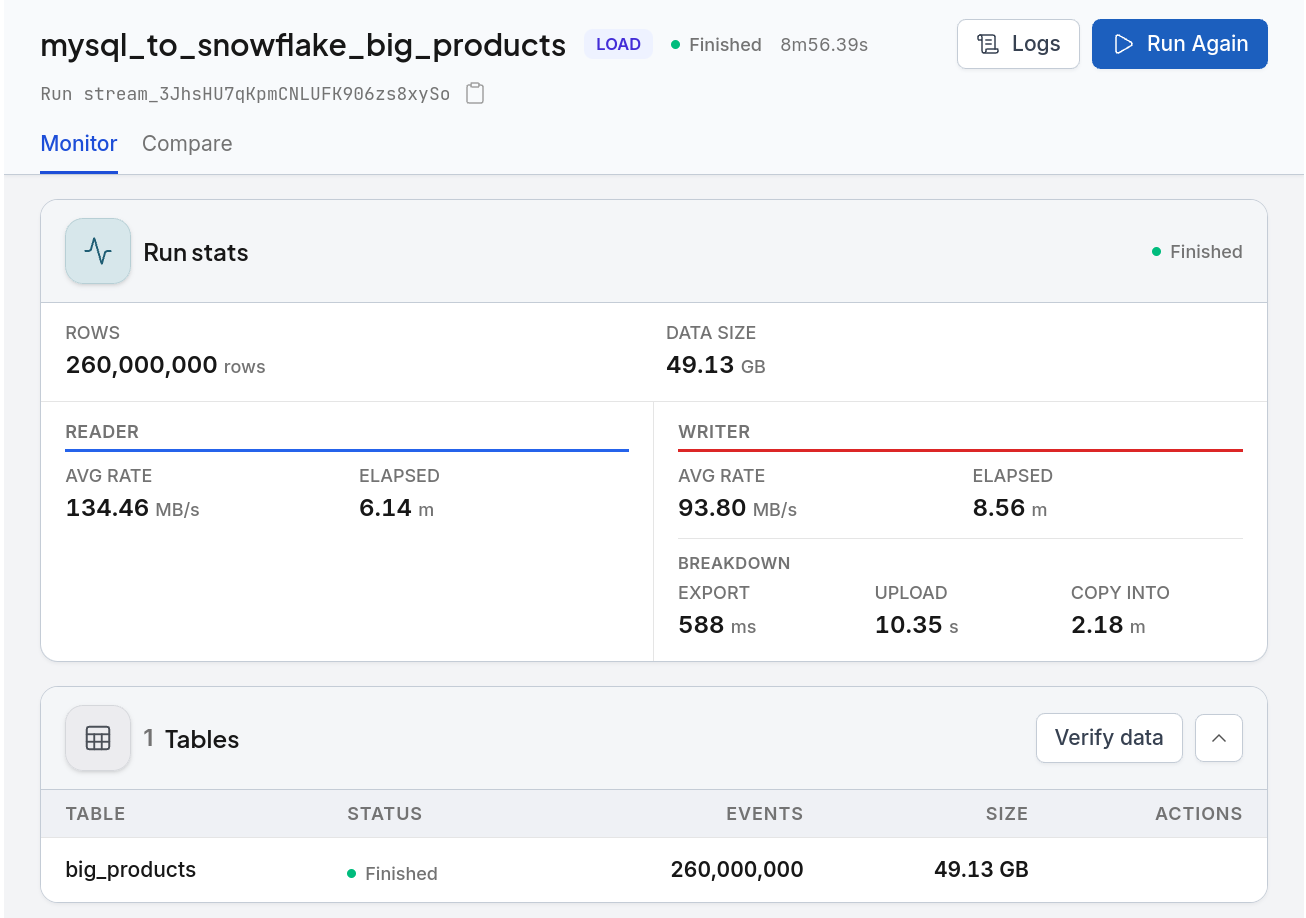
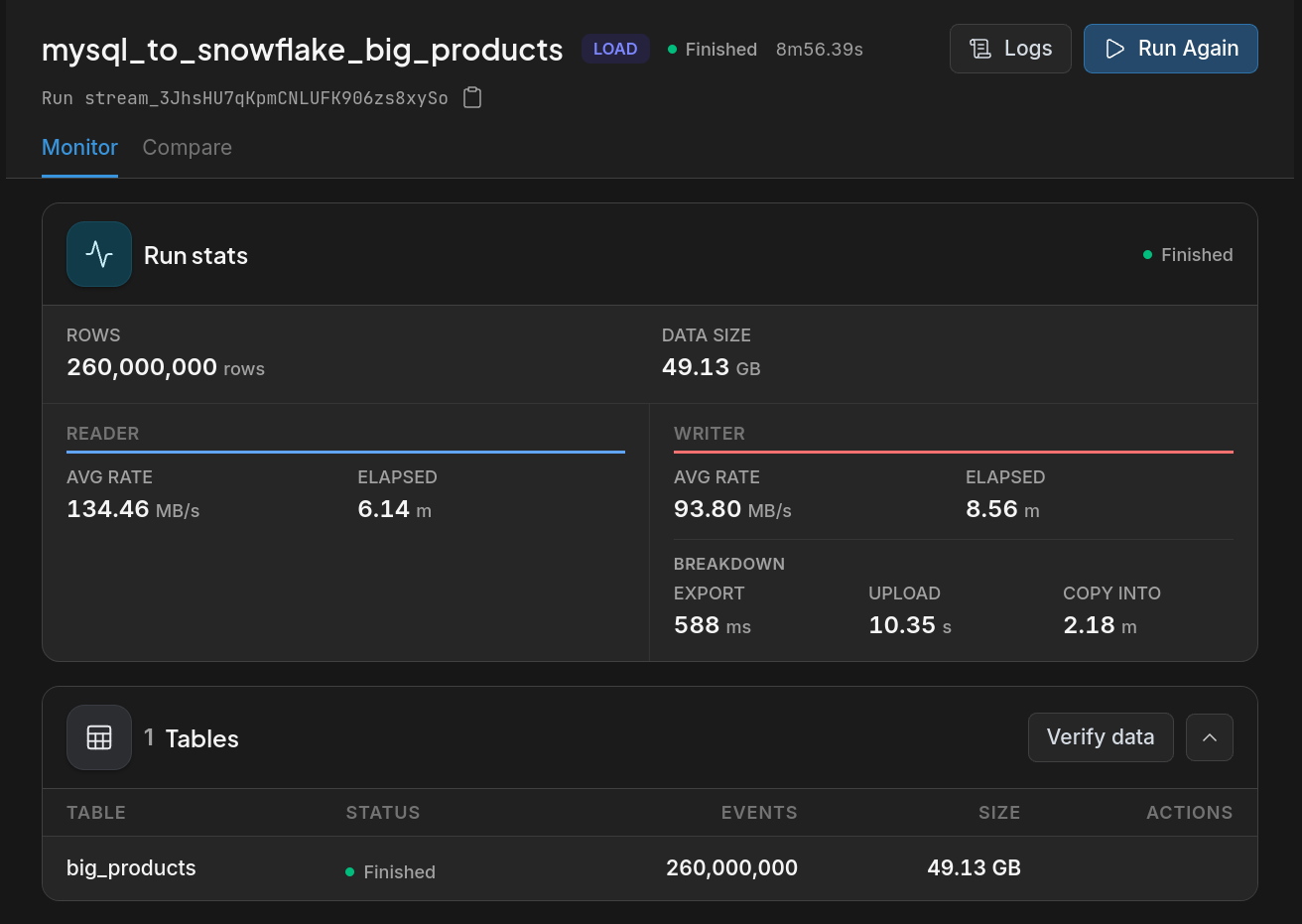
The same table into Snowflake: 49.13 GB in 8 minutes 56 seconds, end to end, including the upload and Snowflake's COPY INTO.
Flexible Migration Scope
More than standard table-to-table migration.
- Full database
- Selected tables
- Filtered tables
- Custom SQL query
- Custom SQL with joins across databases and files
- Local files (CSV, JSON, JSONL, Parquet)
- S3 storage (with compression support)
Example
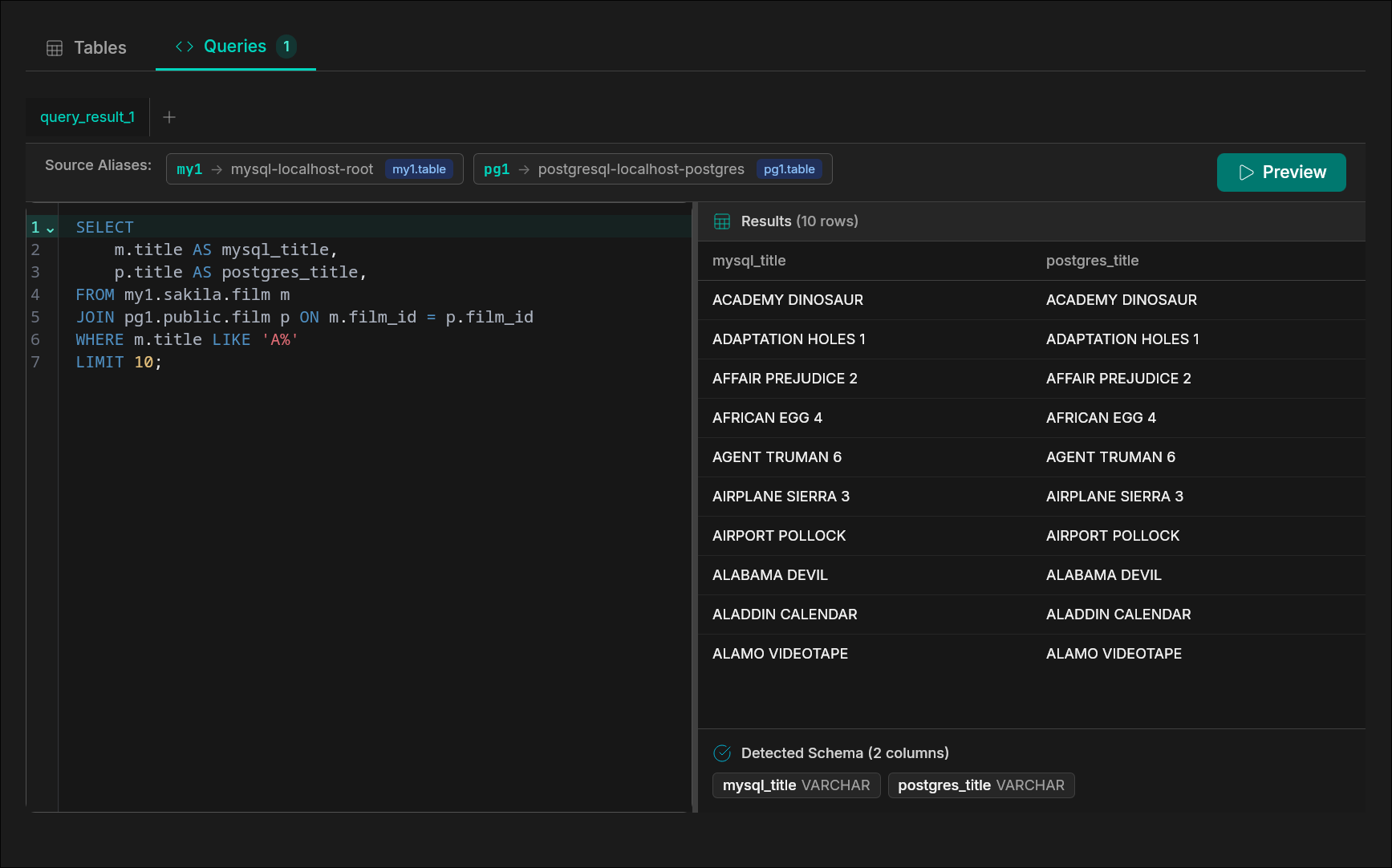
Join a CSV and a production MySQL table, then migrate the result into PostgreSQL — without staging tables. Powered by Cross-database SQL.
Cross-Database SQL in Action
Automatic Schema Conversion & Built-In Validation
No manual DDL rewriting required.
Supported Migration Paths
- MySQL to PostgreSQL
- PostgreSQL to MySQL
- Database to files (CSV, JSON, Parquet)
- Files to database (schema inferred automatically)
- MySQL / PostgreSQL to Snowflake
Schema Conversion Handles
- Automatic MySQL ↔ PostgreSQL type mapping (INT → BIGINT, JSON → JSONB, ENUM → VARCHAR, etc.)
- Index and constraint recreation
- Foreign keys recreated in dependency-safe order
- Tables and column definitions
Database Migration Workflow
1. Define source and scope
Select the source, pick tables or write a SQL query, and apply row filters.
2. Configure schema and write behavior
Choose a schema policy (fail if exists, validate existing, create missing only, or drop and recreate) and a write mode (fail if not empty, append, truncate and load, or upsert) independently for structure and data.
3. Review the plan and run
See which target tables will be created, reused, or dropped before anything is written; dropping tables takes a second confirmation. Data is then read and written in parallel through embedded JetStream.
4. Monitor progress
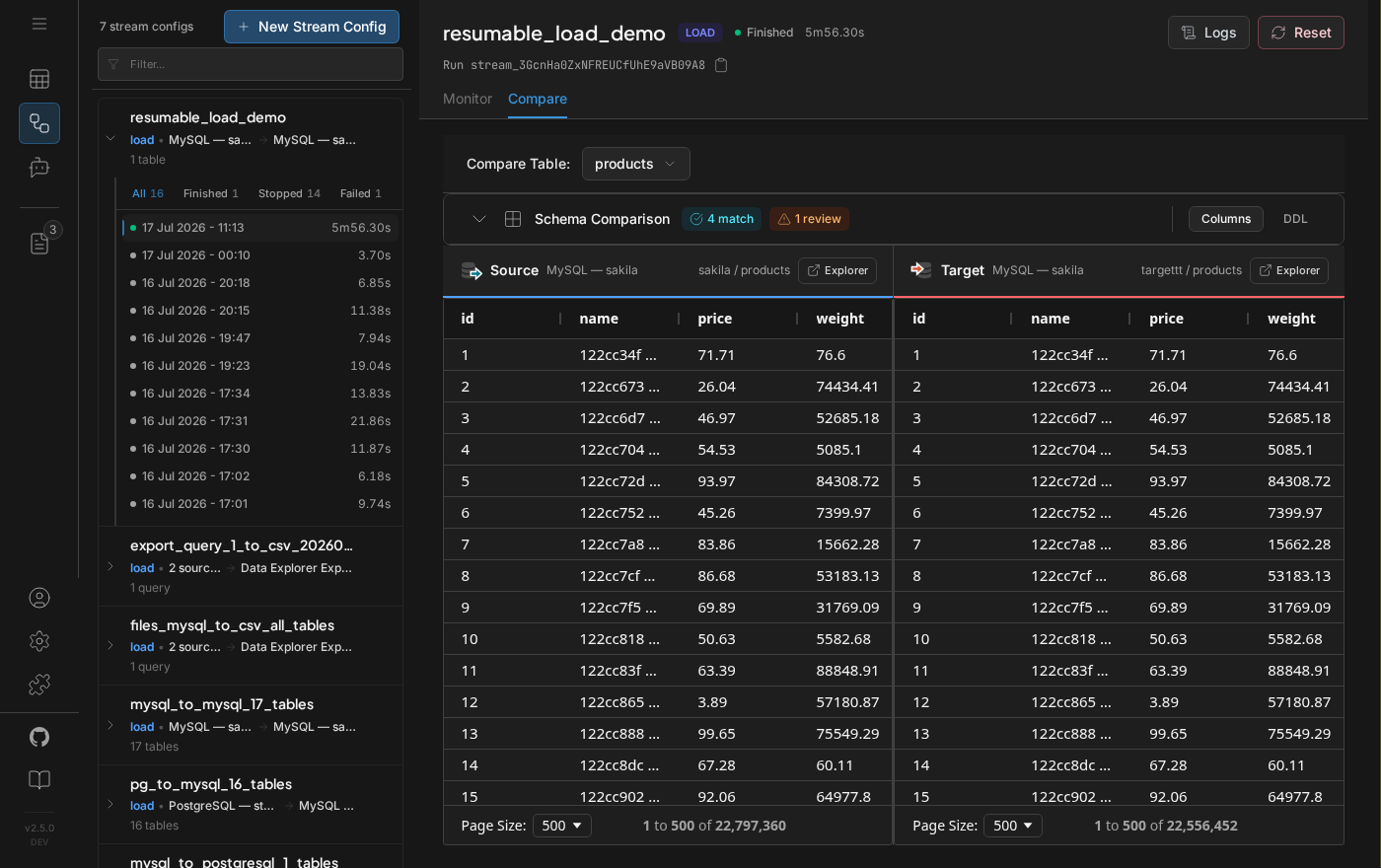
Open a run to track saved rows, chunks, throughput, and table status, then Verify data to compare the result with the source.
Large loads continue from where they stopped
Eligible loads into MySQL or PostgreSQL targets are split into primary-key ranges. A compatible saved state can resume from the last completed chunk; an incompatible one is reset before a fresh load.
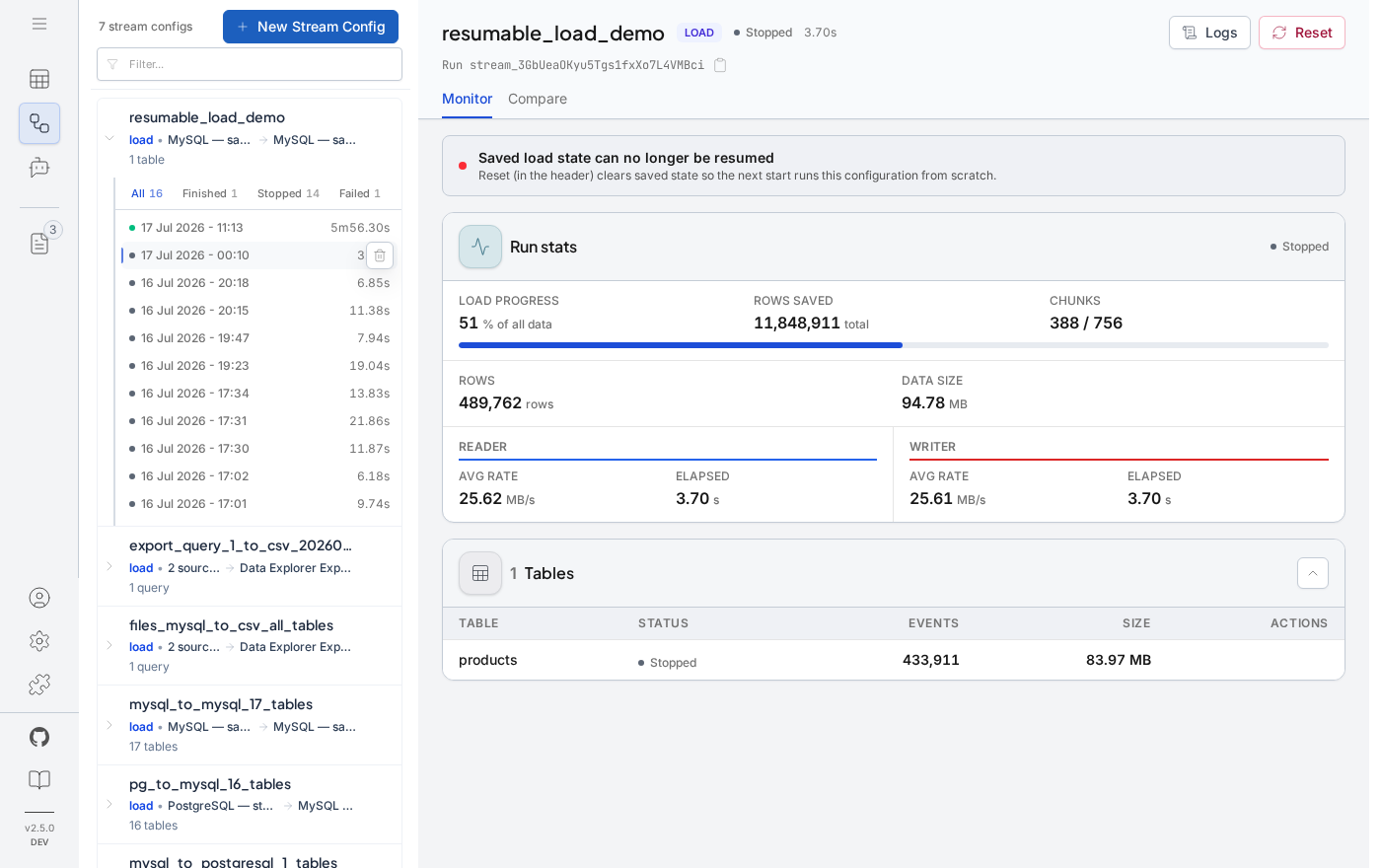
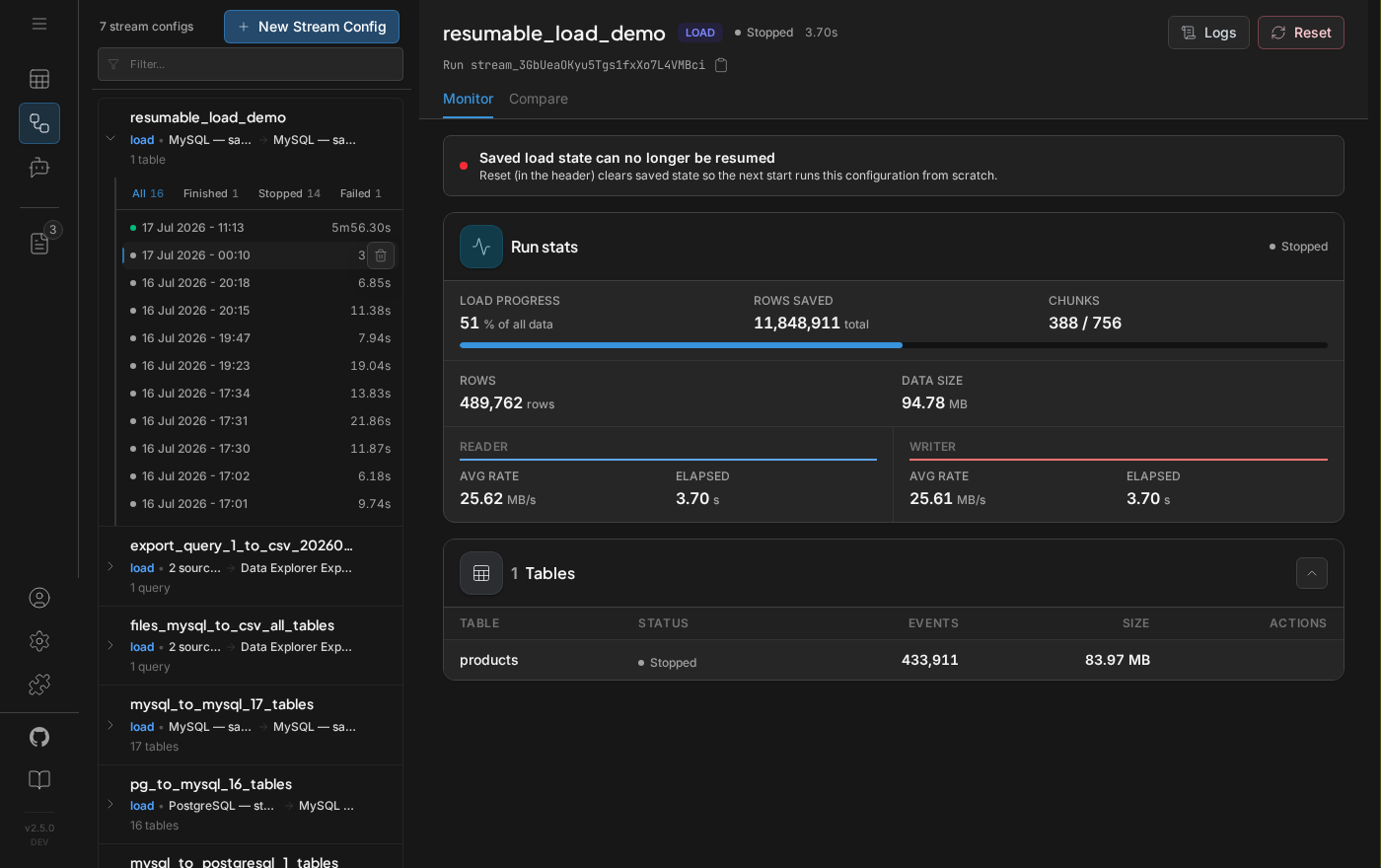
Open the stopped run to review saved rows, chunks, and table status. The config offers Resume Load only while that saved state remains compatible; otherwise Reset prepares a clean rerun.
Prove the target matches the source
Let an AI write the queries. The engine moves the data and proves it landed.
Verify data compares row counts, sums, ranges and text lengths for every table and names the columns that don't match. See them in Compare opens those rows side by side.
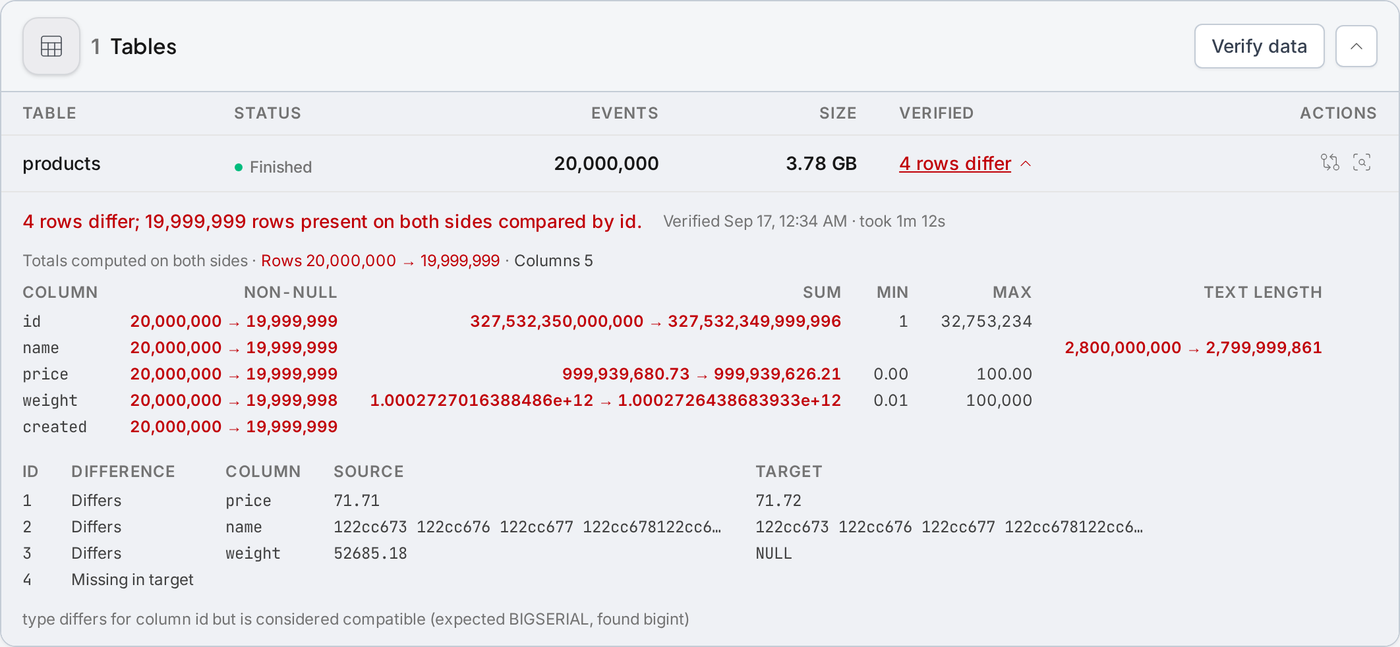
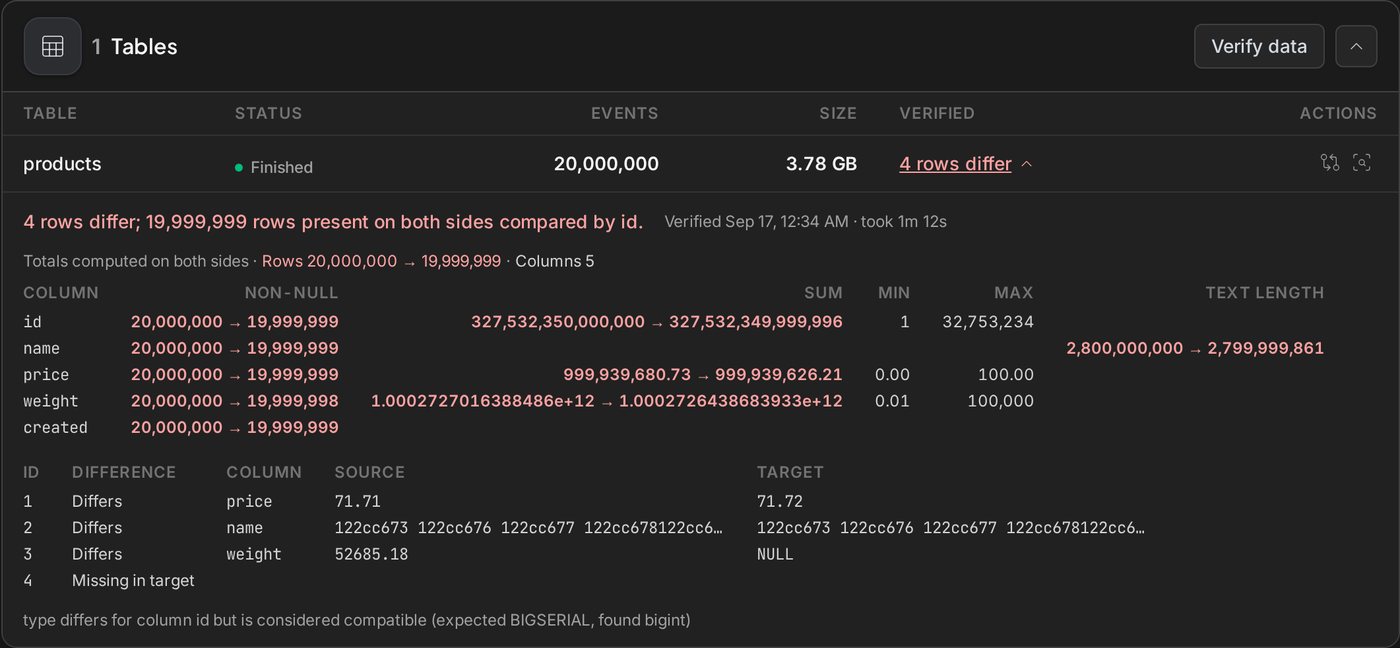
- Tables whose totals differ get a row-by-row comparison automatically
- Turn on Verify data after run to check every load when it finishes
- 20 million rows compared row by row in 72 seconds on a developer workstation
Common Use Cases
MySQL → PostgreSQL Modernization
Move a production MySQL database to PostgreSQL — schema conversion handled automatically.
On-Prem to Cloud Migration
Move self-hosted databases to cloud targets with a staged rollout and planned cutover.
Environment Seeding
Clone a production database subset into staging or dev for testing without affecting the primary.
Source Consolidation
Combine multiple databases and files into a single target database or storage destination.
Operational Exports
Export table or query results to CSV, JSONL, or Parquet in local storage or S3.
Related workflows
Before and after migration
Validate before cutover, build the source from multi-database SQL, or keep the target current after the load finishes.
Validate structure and data first
Inspect schemas, compare what landed, and review data before production migration windows.
Use SQL as the migration source
Build the source dataset from multiple databases, files, or S3-backed inputs before writing to the target.
Keep the target current after the load
Switch to CDC after the load finishes to keep the target current through cutover.
Run a migration test before the cutover window
Verify the converted target against the source, row by row, before you schedule the production move.
A Load pass covers the migration runs themselves: 30 days of clean Load for a one-time price.